
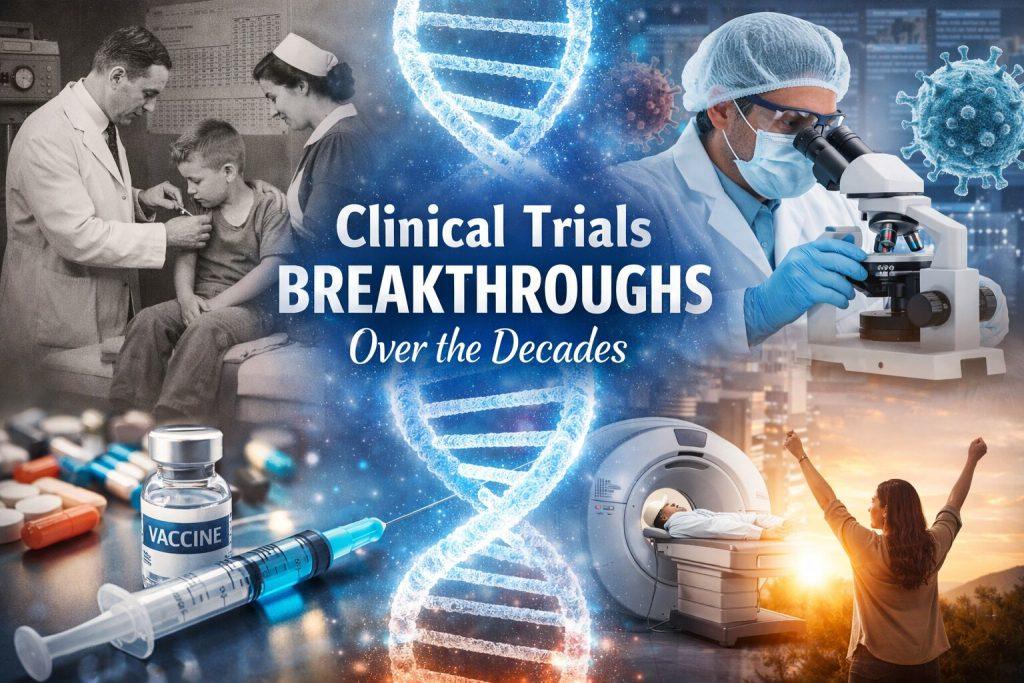
Every medication that exists today cleared a clinical trial before reaching a patient. That is not a technicality. The trial process is where the science either holds up or falls apart, and the history of medicine is largely a record of what happened when it held up. Some of the most significant treatment advances of the last century came directly out of trial data that changed what doctors could offer their patients.
Polio and the Trial That Changed Public Health
The 1954 polio vaccine trial organized by the National Foundation for Infantile Paralysis remains one of the largest and most consequential in history. Nearly two million children participated across the United States. The trial tested Jonas Salk’s inactivated poliovirus vaccine against a placebo in a double-blind design, meaning neither the participants nor the people administering doses knew who received which.
The results came back in 1955. The vaccine was 80 to 90 percent effective against paralytic polio. Within two years of that announcement, polio cases in the United States dropped dramatically. The trial did not just validate a vaccine. It demonstrated what large-scale, rigorously designed research could accomplish and set a standard that shaped how trials were run for decades after.
Cancer Treatment and the Rise of Chemotherapy
The development of chemotherapy as a treatment for cancer ran through a series of clinical trials starting in the 1940s and continuing through the following decades. Early trials on nitrogen mustard compounds in patients with lymphoma showed that tumors could shrink in response to chemical agents. Those results were modest, but they were real, and they opened a new field.
Later trials refined which agents worked for which cancers, what doses produced results without causing fatal toxicity, and how combinations of drugs could outperform single agents. The multi-drug regimen now used for childhood acute lymphoblastic leukemia (ALL) emerged from decades of incremental trial data. Survival rates for childhood ALL went from under 10 percent in the 1960s to above 90 percent today. That trajectory is a direct product of what clinical trials found and built on.
HIV and the Acceleration of Drug Development
The AIDS epidemic in the 1980s forced a rethinking of how clinical trials operated. People with HIV were dying while experimental drugs sat in pipelines that moved too slowly. Activists, researchers, and patients pushed for faster access and more inclusive trial designs. The result was a set of reforms that changed drug development broadly, not just for HIV.
The trials that evaluated zidovudine (AZT) in the mid-1980s were stopped early because the benefit was so clear that continuing to give placebo to the control group was considered unethical. That early stopping decision reflected a principle that carries forward in trial design today. Later trials built the evidence base for combination antiretroviral therapy (ART), which turned HIV from a death sentence into a manageable chronic condition. That outcome is inseparable from the trial data that supported it.
Heart Disease and the Evidence That Changed Practice
Cardiovascular medicine has a long history of clinical trial findings that reversed conventional assumptions. The CAST trial in the late 1980s tested whether drugs that suppressed abnormal heart rhythms after a heart attack would reduce mortality. The assumption going in was that they would. The trial data showed the opposite. Patients on the active drugs died at higher rates than those on placebo.
That result forced a fundamental shift in how cardiologists approached post-heart attack treatment. It also demonstrated something that is easy to overlook: clinical trials do not only confirm what we expect. They correct it. The willingness to test assumptions rigorously, and to follow the data wherever it leads, is what makes the findings useful.
The statin trials of the 1990s are another example. Studies including the Scandinavian Simvastatin Survival Study showed that cholesterol-lowering drugs reduced the risk of heart attacks and death in patients with established heart disease. Those results directly changed prescribing patterns and preventive care guidelines worldwide.
Modern Immunotherapy and What Trials Made Possible
Cancer immunotherapy represents one of the more recent areas where trial data has produced results that would have seemed unlikely a generation ago. Checkpoint inhibitors, a class of drugs that help the immune system recognize and attack cancer cells, moved from early-phase trials to approved treatments over roughly a decade.
The trials supporting pembrolizumab and nivolumab showed durable responses in patients with melanoma and other cancers who had few remaining options. Some of those patients remained in remission years after treatment ended. That kind of outcome changed how oncologists thought about what was achievable in late-stage cancer and opened trial programs across dozens of other cancer types.
Why the Trial Record Matters Now
The treatments described above did not emerge from intuition, theory, or individual case reports. They came from structured research where hypotheses were tested against real outcomes in real patients, with results that either held up or did not. The ones that held up became the foundation for what followed.
Understanding that history is useful for anyone following a new treatment’s development today. A drug entering Phase 3 trials stands on decades of methodological refinement. The framework that produces results now is the same one that found the polio vaccine worked, figured out how to treat childhood leukemia, and showed that assumptions about heart rhythm drugs were wrong.
Leave a Reply