
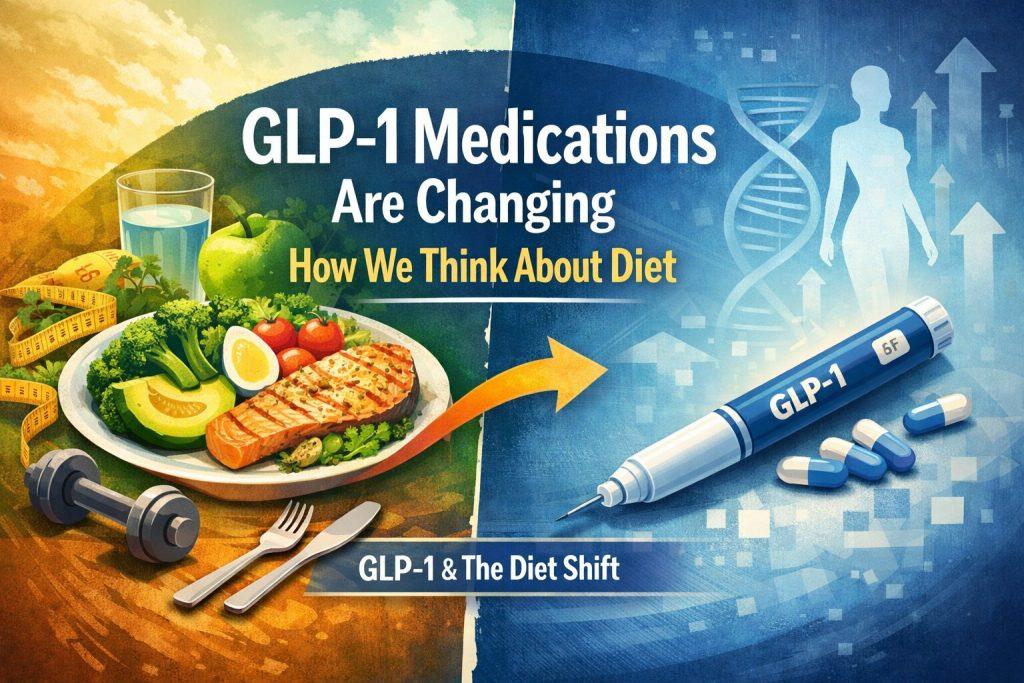
For most of modern nutrition science, the dominant framework for understanding why people eat the way they do has been behavioral and psychological. People overeat because of stress, habit, emotional regulation, food environment, and learned patterns of reward-seeking that develop across a lifetime of experience with food. Dietary interventions built on this framework attempt to change eating behavior through education, meal planning, calorie tracking, structured eating windows, and the cultivation of willpower as the primary mechanism of change. This framework is not wrong. It captures real drivers of eating behavior that genuinely respond to behavioral intervention for many people. What GLP-1 receptor agonists have done is demonstrate, in clinical trial populations numbering in the tens of thousands, that a significant proportion of what we have been calling poor dietary choices is more accurately described as the predictable behavioral output of a hormonal signaling system operating outside its normal parameters. That demonstration does not invalidate behavioral nutrition. It reframes where behavioral intervention is most and least likely to work, and for whom.
The Hunger Biology That GLP-1 Medications Reveal
The most clinically instructive aspect of GLP-1 receptor agonist prescribing is not the weight loss data, which is remarkable enough on its own terms. It is the qualitative experience that patients report within the first weeks of treatment, which is consistent enough across populations, practitioners, and clinical contexts to constitute a meaningful signal about the biology of hunger that was previously invisible.
Patients on semaglutide and tirzepatide describe a phenomenon that clinicians have come to call food noise reduction. Food noise is the persistent, intrusive mental preoccupation with food that characterizes the subjective experience of many people with obesity, the background hum of thoughts about what to eat next, when to eat, how much is allowed, and what the consequences of eating or not eating will be. For many patients, this preoccupation is so normalized that they do not recognize it as unusual until it disappears on the medication and they experience, sometimes for the first time in their adult lives, the absence of food as a constant cognitive presence.
Research published in Obesity has documented this food noise reduction phenomenon through structured patient interviews, finding that the reduction in food preoccupation was among the most frequently cited and most valued effects of GLP-1 receptor agonist treatment, often ranked above the weight loss itself by patients who had previously understood their relationship with food as a character flaw requiring greater discipline. The realization that food noise has a neurobiological substrate that responds to pharmacological intervention is, for many patients, a profound reframe of the story they have told themselves about why dietary change has been difficult for them.
What This Means for Nutritional Thinking
The GLP-1 clinical data challenges two foundational assumptions that have shaped nutritional science, clinical practice, and public health messaging for decades.
The first assumption is that hunger is primarily an accurate signal of the body’s energy needs that should be trusted and responded to proportionally. The research on GLP-1 physiology in people with obesity suggests that this assumption is not universally valid. In a significant proportion of people with obesity, the GLP-1 secretion response to food intake is blunted compared to lean individuals, meaning the postprandial satiety signal that should reduce appetite after an adequate meal is weaker and shorter-lived than it is in people without obesity. Research published in the New England Journal of Medicine on the physiology of obesity has documented this GLP-1 secretion deficit as one of several hormonal dysregulations that create a biological predisposition to overconsumption that is not reducible to behavioral failure. GLP-1 receptor agonists compensate for this deficit by providing the satiety signal that the endogenous hormone is failing to deliver at sufficient magnitude.
The second assumption is that the primary driver of dietary improvement is knowledge and motivation applied through conscious behavioral choice. The evidence from GLP-1 prescribing practice is that many patients experience spontaneous dietary improvement on the medication without deliberate dietary intervention, gravitating toward smaller portions, lower-calorie foods, and reduced frequency of eating as a direct result of altered appetite signaling rather than as the outcome of conscious dietary decision-making. Research published in Diabetes Care found that patients on semaglutide showed significant reductions in preference for high-fat and high-sugar foods measured through validated food preference assessments, with the reductions in preference preceding and partially explaining the dietary changes that contributed to weight loss, independent of any nutrition counseling received.
The Implications for Dietary Counseling
If a meaningful proportion of the difficulty people experience in following dietary recommendations is driven by hormonal signaling deficits rather than behavioral deficits alone, the implications for how dietary counseling is structured and what it can reasonably be expected to achieve are significant.
Current dietary counseling models assume a relatively level playing field in which all patients have equivalent access to the motivational and cognitive resources needed to implement dietary change when given accurate information and structured support. The GLP-1 evidence suggests that this assumption is inaccurate for a substantial subset of patients whose appetite regulation biology creates a headwind against dietary change that counseling alone cannot overcome at a clinically meaningful scale.
This does not mean dietary counseling is ineffective or unimportant. It means that dietary counseling is likely to be most effective when the biological environment in which it is delivered supports the behavioral changes it is recommending. A patient on a GLP-1 receptor agonist whose food noise has reduced, whose postprandial satiety is functioning, and whose preference for high-calorie foods has diminished is in a very different position to implement dietary guidance than a patient whose hormonal environment is working against every recommendation the counselor makes.
Research published in the American Journal of Clinical Nutrition found that the combination of GLP-1 receptor agonist treatment with structured nutritional counseling produced significantly better dietary quality outcomes than either intervention alone at twelve months, measured by dietary quality index scores that captured not just caloric intake but the composition and nutritional adequacy of the diet. The medication created the biological conditions under which dietary counseling could be effectively implemented, and the dietary counseling ensured that the reduced caloric intake enabled by the medication was nutritionally adequate rather than simply smaller.
The Protein and Nutrient Challenge the Medication Creates
The dietary thinking shift that GLP-1 medications require is not only about why people eat but about what they need to eat when appetite is pharmacologically reduced. Reduced appetite is the mechanism through which these medications produce weight loss. It is also a nutritional risk if the reduction in food intake is not managed to ensure that protein, micronutrients, and dietary fiber remain adequate within a smaller caloric envelope.
Research from the SURMOUNT-1 trial documented that a meaningful proportion of weight lost on tirzepatide was lean mass rather than fat alone in participants who did not receive specific nutritional guidance about protein intake, a finding that has significant implications for the long-term metabolic and functional outcomes of GLP-1 treatment. Muscle mass loss reduces resting metabolic rate, impairs physical function, and creates the conditions for weight regain when the medication is discontinued or its dose is reduced.
The dietary framework that the evidence supports for people on GLP-1 medications is therefore not simply eat less, which the medication achieves automatically, but eat differently within a smaller total intake. Higher protein density per meal, prioritization of nutrient-dense whole foods over calorie-dilute processed foods, and deliberate attention to micronutrient adequacy through food choice and targeted supplementation are the nutritional principles that protect against the deficiency risks that pharmacologically reduced appetite creates.
The Broader Cultural Shift
The cultural implications of GLP-1 medications for how society thinks about diet extend beyond clinical practice into the broader public conversation about obesity, food choice, and personal responsibility. The medications provide a biological demonstration that the difficulty many people experience with dietary change is not simply a matter of insufficient effort or inadequate information, and that the standard public health messaging framework of eat less and move more has failed not because people lack access to that advice but because the biological environment in which they are trying to implement it has not been adequately considered.
This reframe does not eliminate the importance of dietary behavior or the value of nutritional education and counseling. It repositions them within a more accurate biological model that acknowledges the hormonal and neurological drivers of eating behavior alongside the behavioral and environmental ones. A nutritional framework that integrates biological, behavioral, and environmental drivers of eating behavior is both more scientifically accurate and more practically useful than one that treats dietary choice as primarily a matter of knowledge and willpower applied in a biological vacuum.
The GLP-1 vs bariatric surgery options comparison examines the specific clinical decision between pharmacological and surgical approaches to obesity management in the detail that patients and clinicians need to make informed treatment decisions, and it sits alongside this broader reframing as a companion piece that addresses the practical treatment question within the conceptual framework that GLP-1 medications have helped to clarify.
Leave a Reply